
▪︎ 1. Rising Controversy Over Mongol Shobhajatra
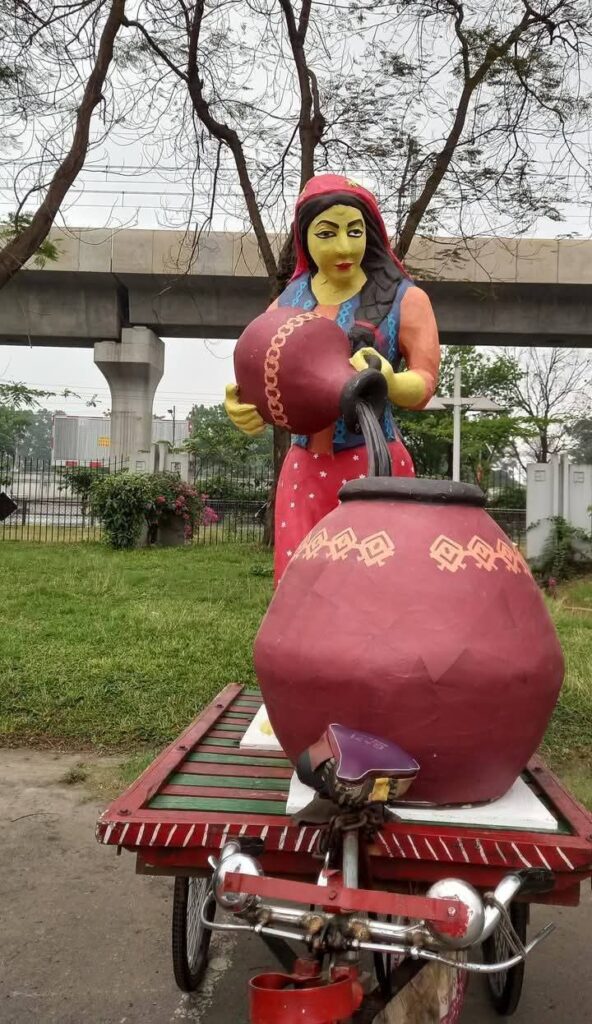
- For several years, many Muslims in Bangladesh have objected to the Mongol Shobhajatra, a traditional procession organized by Dhaka University’s Fine Arts faculty on Pohela Boishakh.
- They repeatedly labeled it as a “Hindu cultural practice” and even targeted it for attacks.
As a result, during the Awami League government, police protection became necessary for the procession, which diluted its traditional grandeur.
▪︎ 2. Renaming Under the Interim Government
- Under the current interim government, the name of Mongol Shobhajatra was changed to Anondo Shobhajatra (Joyful Procession) in an attempt to depoliticize or neutralize its cultural undertones.

▪︎ 3. Hypocrisy in Cultural Expression
- Ironically, on March 31, 2025 (Eid Day), some of the same Muslims who criticized Mongol Shobhajatra for its use of “idols” organized a colorful procession featuring Arabian Nights characters.
- This has exposed a contradiction—those who once condemned symbolic art now used similar themes in their own cultural expressions.
- Outcome: They can no longer validly criticize Mongol Shobhajatra’s visuals or cultural symbolism.

▪︎ 4. Practicing Hindus and the Deep Roots of Pohela Boishakh
- Practicing Hindus have been celebrating Pohela Boishakh for centuries.
- The name of each Bengali month is derived from seasonal changes and celestial alignments found in the ancient Hindu astronomical text “Surya Siddhanta”.

▪︎ 5. Vikrami Calendar: The True Origin
- The Vikrami Calendar was initiated by King Vikramaditya based on the Surya Siddhanta, and is still followed in Nepal, North India, and Punjab.
- While the Vikrami calendar starts with the month of Chaitra, it celebrates Baisakh as the major harvest festival.

▪︎ 6. Significance of the Month in Northern India and Punjab
- In Northern India and Punjab, this month is celebrated as a festival of agriculture, especially for wheat cultivation.
- It marks the beginning of the harvest season, making it an important time for farmers.

▪︎ 7. Adoption of the Vikrami Calendar by Sikhs
- The Vikrami calendar has been adopted by the Sikh community.
- This adoption is based on the teachings of Guru Gobind Singh Ji, the 10th Sikh Guru, as mentioned in the Guru Granth Sahib.
︎ Establishment of Khalsa
- Guru Gobind Singh Ji declared the formation of the Khalsa on the first day of Vaisakh.
- This historic event took place on 14th April 1699.
- The establishment of the Khalsa was aimed at:
° Protecting the Sikh faith.
° Establishing justice and righteousness in society.
▪︎ 8. Vikrami Calendar and Its Origins
- The Vikrami Calendar is based on the solar year.
- It derives its system from an ancient Sanskrit astronomical text called the Surya Siddhanta.
- The Surya Siddhanta is centered around Surya Dev (Sun God), a significant figure in Sanatan Dharma (Hinduism).
- This text describes:
° The names of each month in the Bengali calendar.
° Seasonal and natural changes for each month.
° The positions of planets and stars during different times of the year.
▪︎9. Influence on the Bengali Calendar (Bongabdo)
- Inspired by the Vikrami Calendar, King Shashanka of Gour (Undivided Bengal) observed the climate and astronomical patterns of Bengal.
- He established the Bengali calendar (Bongabdo) using Baisakh, the second month of the Vikrami calendar, as the first month of the Bengali year.
- The calendar was officially introduced in 593 AD, aligning with planetary positions and Bengal’s seasonal characteristics.
▪︎ 10. Variation in Bengali New Year Date
- Due to its solar nature, the Bengali New Year falls on either April 14th or 15th, depending on the astronomical alignment each year.
- The system follows solar calculations similar to the Vikrami calendar.
▪ 11.︎ Calculation of the Bengali Year
- The Bengali calendar (Bongabdo) started in 593 AD.
- By subtracting 593 from 2023:
° 2023 – 593 = 1430
° Thus, the Bengali Year is 1430.
▪︎ 12. The Myth of Emperor Akbar Initiating the Bengali Calendar.
- The claim that Emperor Akbar introduced the Bengali calendar is a historical distortion, much like the Aryan Invasion Theory, which attempts to undermine the indigenous Hindu cultural roots of the land.
- This narrative is now being challenged and debunked as a communal and misleading strategy.
Flawed Timeline Argument
- It is widely said that Akbar introduced the Bengali calendar in 1575 AD for tax collection purposes.
- However, if we calculate the Bengali year based on this claim:
° From 1575 to 2023, the total span is 448 years.
° So, according to this theory, the Bengali year should be 448, not 1430, which clearly doesn’t add up.
︎ ▪︎ 13. Mughal Invasion and Cultural Agenda
- The Mughals entered India from Central Asia with the aim of conquest under the banner of religion.
- Their goal was to subjugate the Indian subcontinent and turn it into a center of domination.
- Along with them, they brought the culture and practices of Arabia.
▪︎ 14 . Introduction of the Hijri Calendar
- The Mughals followed the Hijri calendar, which is based on the lunar cycle—specifically the positions of the new moon (Amavasya) and full moon (Purnima).
- This calendar system is native to Arab lands and was used in India during Mughal rule.
︎ Mismatch Between Hijri Calendar and Indian Seasons
- Although the Hijri calendar was impliment in India , it did not align with the natural cycles and agriculture patterns of the Indian Subcontinent.
- Indian life – farming , season , climate and rituals is better synchronised with the solar based Vikrami calendar, rooted in Sanatan Dharma.
▪︎ 15. Economic disruption from Luner Calender
- A major flaw in the Hijri system was its Mismatch with solar time .
° 33 Luner Years = 32 Solar years
° This meant that within 33 Luner years 32 Solar year would pass .
- As a result , peasants were forced to pay an extra year of tax every 33 years.
- This discrepancy led to growing dissatisfaction and unrest among the population .
▪︎ 16. Akbar the Thief: Why He Cannot Be the Creator of the Bengali Calendar
- The Vikrami Calendar Existed Long Before Akbar
- Emperor Akbar, often credited by some as the initiator of the Bengali calendar, merely appropriated a system that had existed long before his time.
- The Vikrami calendar, which he tried to rebrand, was already in use by Hindus for centuries.
- Akbar, in this case, acted more like a calendar thief than a creator.
- A Muslim Ruler Would Not Use Hindu Deities in a Calendar
- If Akbar had truly invented the Bengali calendar:
° The months would not be named after Hindu gods and cultural terms.
° No devout Muslim emperor would establish a calendar with such Hindu religious associations.
° This is clear proof that the Bengali calendar is rooted in Hindu tradition, not in Mughal reform.
▪︎ 17. Historical Evidence: The Legacy of King Shashanka
- Boishakh and the Bengali New Year
- The Vikrami calendar’s second month, Boishakh, is the month from which Bengali New Year is celebrated.
- It was King Shashanka, a Hindu ruler who lived centuries before Akbar, who began this tradition.
- Akbar merely manipulated the calendar for revenue collection and administration — not cultural or religious purposes.
▪︎ 18. The Hindu Solar Calendar: A System of Precision
- A Calendar Rooted in Astronomy
- The Hindu solar calendar is so accurate that:
- Even 100 years ago, scholars could predict the exact dates of Eid, Christmas, and the English New Year.
- This proves that Hindu timekeeping is not only ancient but astronomically precise, managed solely by Hindu astrologers and scholars..
▪︎ 19. Evidence: Bengali Months Match the Vikrami (Hindu) Calendar
Common Roots with the Vikrami Calendar
- The Bengali months align directly with the Vikrami calendar, also known as the Hindu solar calendar.
- This calendar system is not unique to Bengal alone — it is followed in different forms across the Indian subcontinent. Observed by Punjabi Muslims and Sikhs
- Punjabi Muslims in Pakistan also follow a similar calendar where the first month is Chaitra, just like in the Hindu calendar.
- Sikhs also observe this solar calendar in their religious and cultural traditions. Regional Variations Prove Independent Origins
- To show they did not copy this tradition from Hindus:
° Sikhs celebrate Vaisakhi (Boishakh) on April 14, which is one day before the Bengali Pohela Boishakh (April 15).
- This is similar to how Islamic Hijri New Year or Christian Lunar events like Easter shift based on the moon or calendar systems.
- The slight variation in dates does not indicate borrowing, but independent adaptation of the same solar-based system.
▪︎ 20. The Accuracy and Legacy of the Hindu Solar Calendar
Based on Celestial Movements
- The Hindu solar calendar follows the sun’s exact position and planetary alignments, making it incredibly accurate.
- As a result, each day and each year can be calculated to fall at a fixed, predictable time.
Unmatched by Other Systems
- Unlike lunar calendars, the solar calendar doesn’t shift unpredictably.
- This makes precise year-counting and festival planning possible — a system that remains under the sole expertise of Hindu astrologers.
Conclusion
The celebration of Pohela Boishakh is deeply entrenched in Hindu astronomical and cultural traditions that predate Islamic influence in Bengal. The Mongol Shobhajatra controversy reflects broader socio-political tensions, but the roots of this festival—and the calendar it’s based on—remain unmistakably Indic. Attempts to rewrite history or obscure these facts cannot hold against the depth of historical, astronomical, and cultural evidence.